
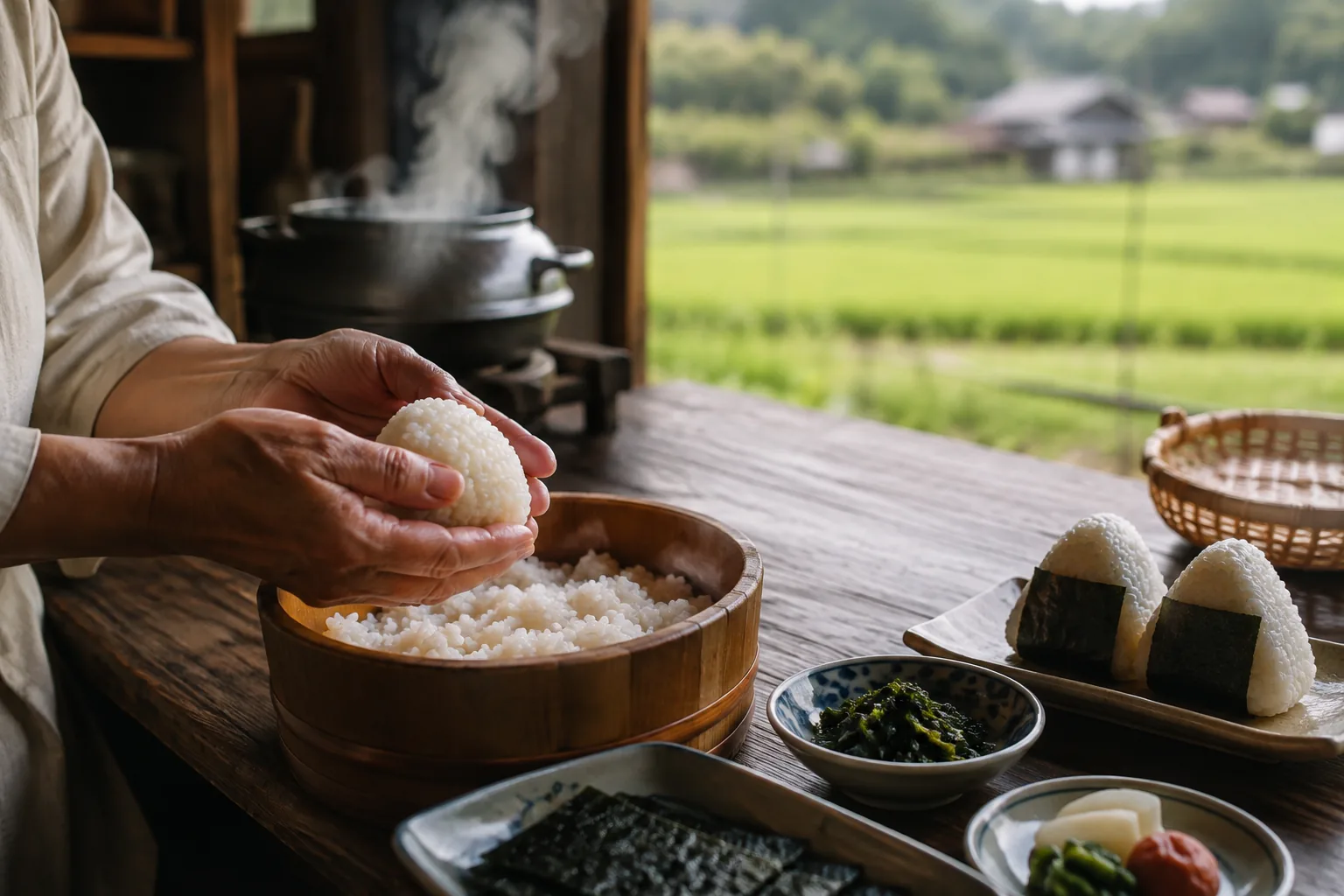
Onigiri may be the most ordinary food in Japan.
You find it in convenience stores, train stations, supermarkets, school lunches, hiking bags, and family kitchens. It is portable, inexpensive, and familiar. For many Japanese people, it carries the same emotional weight as a homemade sandwich or a packed lunch made by someone who knows you well.
But the onigiri most travelers encounter is usually the fastest version: neatly wrapped, perfectly shaped, and eaten between destinations.
Travel into the Japanese countryside, cook the rice slowly, and shape it while it is still warm, and the same simple food becomes a completely different experience.
The rice matters more than the filling
Visitors often begin with the filling. Salmon or tuna mayonnaise? Pickled plum or kombu? These choices are part of the fun, but a good onigiri begins before anything is placed inside it.
Japanese short-grain rice has the soft, slightly sticky texture needed to hold together without becoming dense. When freshly cooked, the grains should remain visible while still clinging gently to one another. The natural sweetness and aroma of the rice are not background flavors. They are the center of the dish.
That is why the best onigiri can be surprisingly simple. A little salt, a sheet of nori, and warm rice may be enough.
Japan’s Ministry of Agriculture describes onigiri as rice shaped by hand around familiar fillings such as grilled salmon, umeboshi, or seasoned bonito flakes. The ingredients vary by household and region, but the basic idea stays the same: rice becomes something personal, portable, and ready to share.
What cooking rice in a kamado changes
A traditional kamado uses fire rather than an electric heating element. Managing it requires attention. The heat builds, the water begins to move, steam escapes, and the cook listens for changes inside the pot.
This method can produce rice with a plump texture, a gentle sweetness, and a faint toasted aroma. More importantly, it makes the process visible.
In a modern rice cooker, the work disappears behind a button. With a kamado, you notice the wood, the flame, the timing, and the pause before the lid is opened. Cooking becomes part of the experience rather than preparation that happens out of sight.
For travelers, this is a small but meaningful glimpse into an older rhythm of Japanese daily life.
Why onigiri is shaped by hand
Making onigiri looks easy until you try it.
The rice is warm. Too much pressure makes it heavy. Too little pressure and it falls apart. The filling needs to stay inside, the surface needs to hold, and the final shape rarely looks as perfect as the version in a convenience store.
That imperfection is part of its character.
Homemade onigiri carries the shape of the hands that made it. A parent may pack it for a child. A friend may bring it on a trip. Families prepare it for picnics, sports days, and long journeys. The food is practical, but the act of making it often expresses care without needing to say very much.
When you shape your own onigiri, you are not only learning a recipe. You are taking part in a gesture repeated in Japanese homes for generations.
A food experience that moves at countryside speed
Many food activities in Japan take place in busy city studios. They are convenient, polished, and easy to fit between sightseeing stops.
The countryside offers something different.
In Nose Town, in northern Osaka Prefecture, the landscape begins to open. Rice paddies, wooded hills, local farms, and traditional homes replace the dense rhythm of central Osaka. The setting changes how the meal feels.
You wait for the rice rather than rushing it. You choose simple seasonal fillings. You eat onigiri near the place where the ingredients were grown, sometimes outdoors when the weather allows. Conversation has room to unfold.
The quiet is part of the experience.
What you can learn from one rice ball
Onigiri connects several parts of Japanese culture in a form small enough to hold in two hands.
It reflects respect for rice as a staple food. It shows how regional ingredients enter everyday cooking. It demonstrates the value placed on seasonality, careful preparation, and avoiding waste. It also reveals a preference for food that travels well without losing its identity.
This is why onigiri appears in so many different settings. It can be breakfast from a convenience store, lunch made at home, food for a train journey, or a regional specialty wrapped in local leaves or seaweed.
The form is simple enough to adapt, but familiar enough to feel like home.
What to expect from an onigiri-making experience near Osaka
The Crazy Escape countryside experience takes place in Nose Town, away from the usual Osaka sightseeing route.
Guests experience the process from cooking rice in a kamado to shaping onigiri by hand. Seasonal ingredients and locally grown rice keep the focus on the region rather than on restaurant-style presentation. The meal is enjoyed at a relaxed pace, surrounded by the rural scenery that gives the experience its meaning.
You do not need professional cooking skills. The point is to notice the details: how the rice smells when the lid opens, how much pressure your hands use, how a simple filling changes the taste, and how different food feels when you are not eating it in a hurry.
It is suitable for travelers who want to experience everyday Japan from the inside, especially those looking for a quieter half-day beyond the crowds of Osaka and Kyoto.
The simplest foods often tell the deepest stories
Japan has elaborate meals, refined techniques, and famous restaurants worth traveling for. But not every meaningful food experience needs to be complex.
Sometimes it begins with rice, salt, warm hands, and enough time to pay attention.
Onigiri is easy to find throughout Japan. Making it in the countryside helps you understand why it has remained so important.
Discover the Onigiri Making in the Japanese Countryside experience.