
Somewhere in the architecture of modern travel, a decision was made — quietly, collectively, without anyone voting on it — that more is better. More sites, more neighborhoods, more experiences logged before dinner. The five-day Japan itinerary now routinely contains what a thoughtful traveler might once have spread across three weeks. The result is a particular kind of exhaustion that is not physical: the sense of having been somewhere without having arrived.
Japan, of all the countries that receive mass tourism, is the one most poorly served by this logic. Not because it lacks quantity — it has more UNESCO sites, more Michelin stars, more distinct regional cultures per square kilometer than almost anywhere on earth — but because its deepest cultural forms are structured around the opposite principle entirely. They are built on reduction. On the removal of everything that is not essential. On the understanding that a single thing, done with full attention, contains more than a hundred things done at speed.
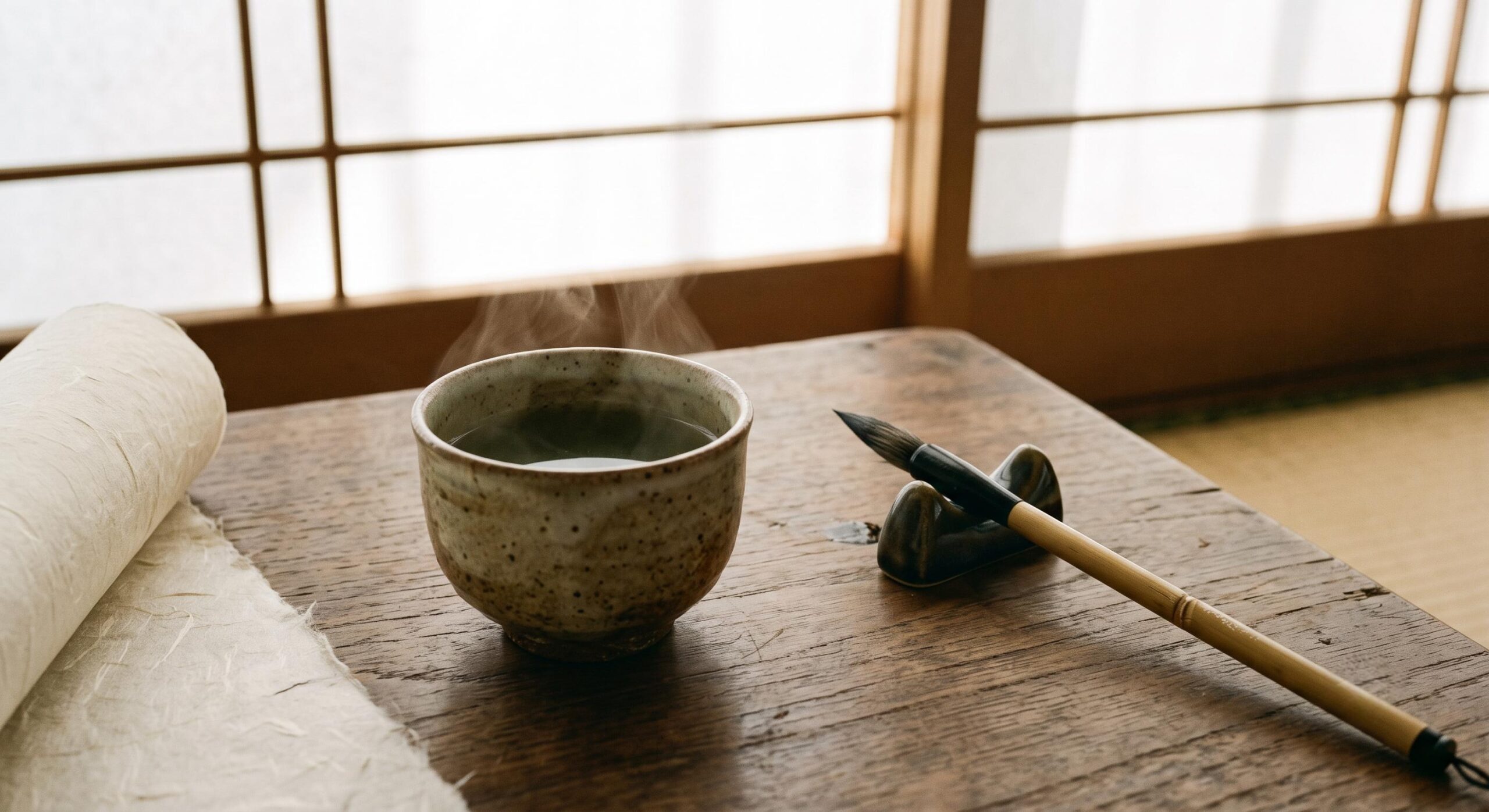
The experience called Shodō Meets Tea begins not with a brush, but with a cup.
Before anything is written, the tea arrives. You drink it. The aroma settles the room. Your breathing adjusts without being asked to. This is not incidental — in Japan, the preparation of the mind precedes the action of the hand. The tea is not a preamble. It is the first half of the work.
Then comes the brush. And here is the detail that changes everything: you are not writing with ink. You write with paste — nori — applied by brush to the shikishi board, and then tea leaves are scattered across the stroke. As the leaves settle into the adhesive, a texture emerges that no ink can replicate: fibrous, dimensional, alive in a way that reveals itself fully only as it dries. The final piece looks, more often than not, better than the hand that made it expected. This is not accidental. It is the logic of the material: the tea leaves do not follow the brush perfectly, and that imperfection is the point.
There is no erasing. There is no second draft. In shodō, every stroke is final, which means every stroke is a small act of commitment — the exact record of your attention, your hesitation, your intention in that precise moment.
You write one character. Not a sentence, not a paragraph — one kanji, chosen by you, representing something you want to define, decide, or carry forward. The instructor, a calligraphy artist, guides you through the fundamentals: how to hold the brush, the essential movements of hane, harai, and tome — the upward flick, the sweeping finish, the deliberate stop. You practice with a water brush first. When you are ready, you apply the paste and scatter the leaves. The character reveals itself as it dries.
The whole session runs ninety minutes, in a small group of no more than five people, in a quiet room in Suehirocho, Tokyo — close to Ueno, far from the itinerary.
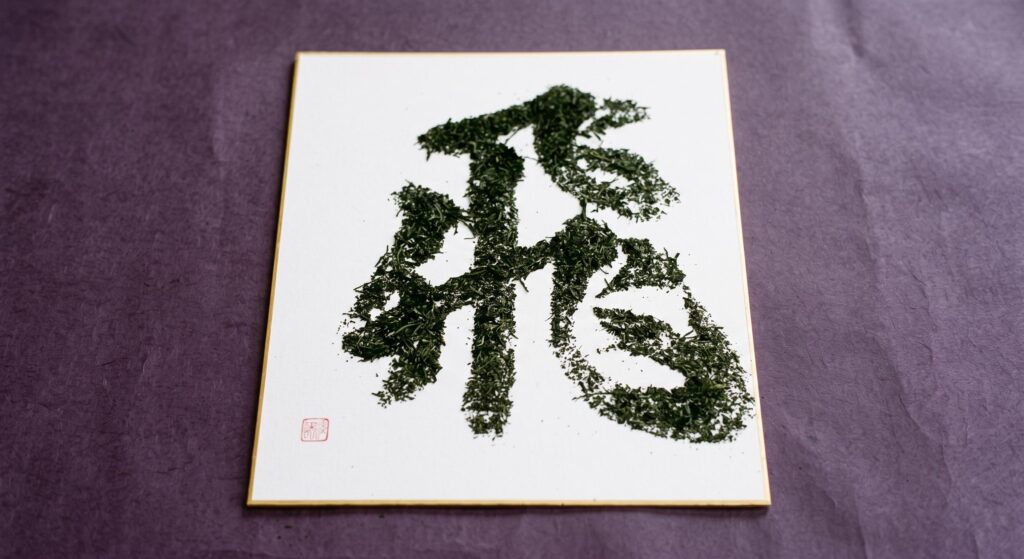
What you take home is an 18 by 21 centimeter mounted artwork that still carries the faint scent of tea. What you take home that is not in the artwork is harder to describe: the particular quality of attention that the session demanded, and the discovery that you were capable of it.
This is not about writing beautifully. It is about writing honestly. And in ninety minutes, in a room that smells of tea, with a single character drying on a board in front of you — that distinction becomes surprisingly clear.
One thing at a time. It turns out this is harder than it sounds, and more valuable than most itineraries allow.