
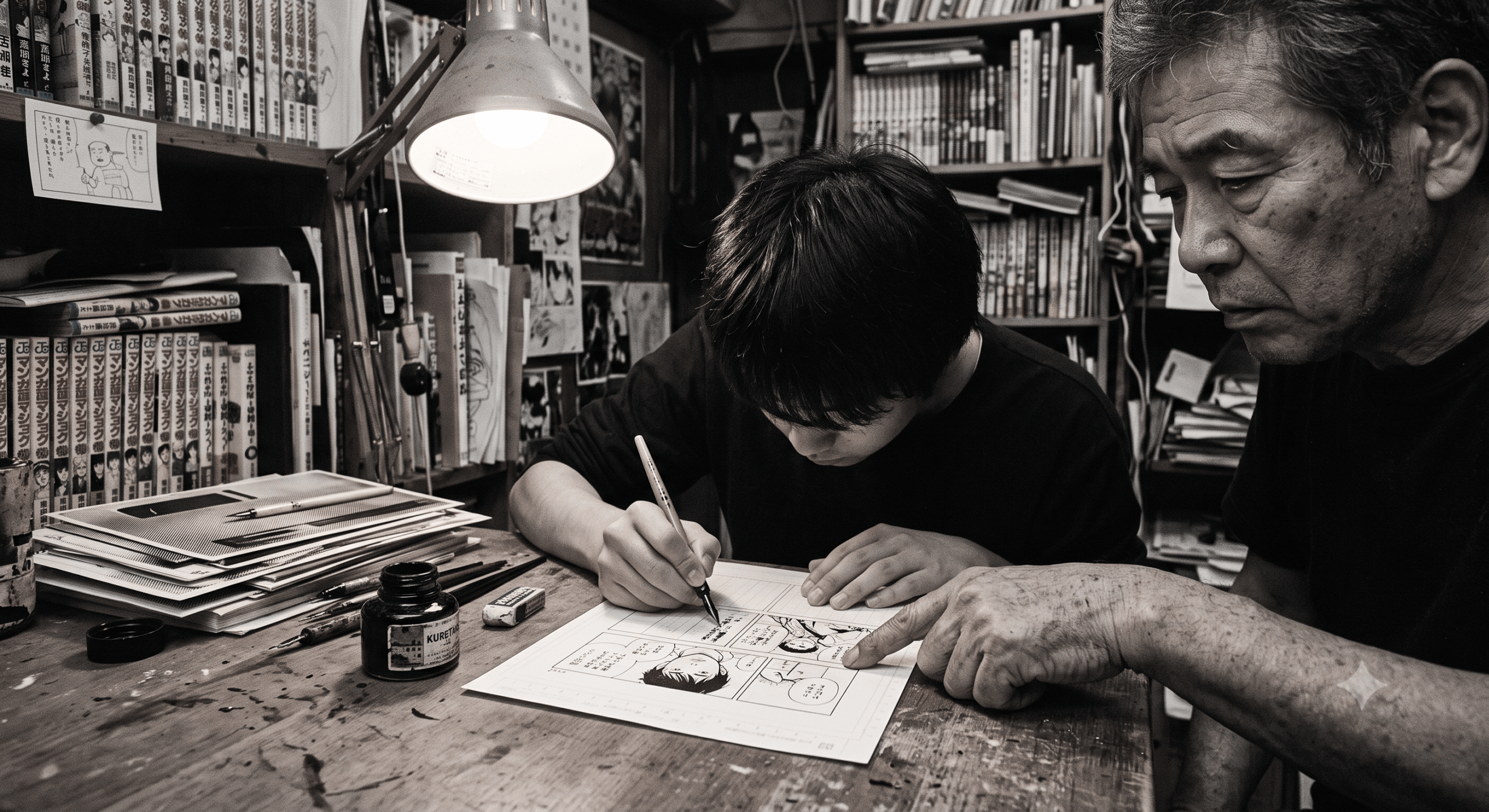
There is a persistent Western misconception about manga: that it is a product, something consumed in bulk on a commuter train or a childhood bedroom floor, disposable in the way that mass entertainment is disposable. This is understandable. It is also almost entirely wrong. Manga is, at its technical core, one of the most demanding visual storytelling disciplines in the world — a form governed by a grammar of panel composition, ink weight, spatial rhythm, and emotional timing so precise that Japan’s dedicated manga schools train students for years before they are considered ready to submit a single page to a publisher.
That context matters when you sit down with a G-pen for the first time.
The G-pen — a steel nib fitted into a wooden holder, dipped in India ink — is the primary instrument of professional manga production, and it is, by design, unforgiving. Pressure determines line weight. Hesitation shows. The hand that draws manga professionally has learned, over thousands of hours, to move with a particular combination of speed and control that cannot be faked and cannot be rushed. When Nihon Mangajuku, Japan’s first dedicated manga school, opens its doors to a small group of outsiders for a single session, what they are offering is not a craft afternoon. It is a supervised encounter with that discipline — abbreviated, guided, and stripped to its essentials, but real in the way that only contact with the actual thing can be real.
The session begins with panel layout — the architecture before the art. Where a panel sits on the page, how large it is relative to its neighbors, what angle the eye enters and exits: these are not aesthetic choices made by instinct. They are a learned vocabulary, developed over decades of manga history, refined by editors and artists in a feedback loop that the rest of the world’s comic traditions have approached but rarely matched. A beginner spending forty minutes on panel composition is not going to master it. They are, however, going to understand for the first time why the page of a Naoki Urasawa manga feels the way it feels — why the silence in a panel lands with the weight of a sentence, why a close-up of a hand can carry more narrative freight than a page of dialogue.
Then comes the ink. The G-pen demonstration by the instructor is worth the price of admission on its own: watching a trained hand produce a clean, variable-weight line in a single unhesitating stroke reframes everything you thought you understood about the form. Your own attempt will not look like that. It will look like what it is — a first attempt, honest and instructive and yours. The screen tones applied in the final phase — adhesive sheets of patterned grey used to suggest shadow, texture, and depth — complete the page in a way that is both technically specific and, when it works, quietly satisfying.
You leave with the manuscript paper, a frame, and a drawing kit: G-pen holder, nibs, brush pen. The physical objects of a practice. Whether you continue with them is beside the point. What you carry out that isn’t in the kit is a recalibrated understanding of what manga actually is — not a product, not a genre, not a cultural export flattened by distance and convenience. A discipline. One that Japan has been refining, with considerable seriousness, for the better part of a century.
[Beyond the Filter] One day. One page. The tools, the technique, and the school that has trained Japan’s professional manga artists. ➔ Inside Japanese Manga Experience