
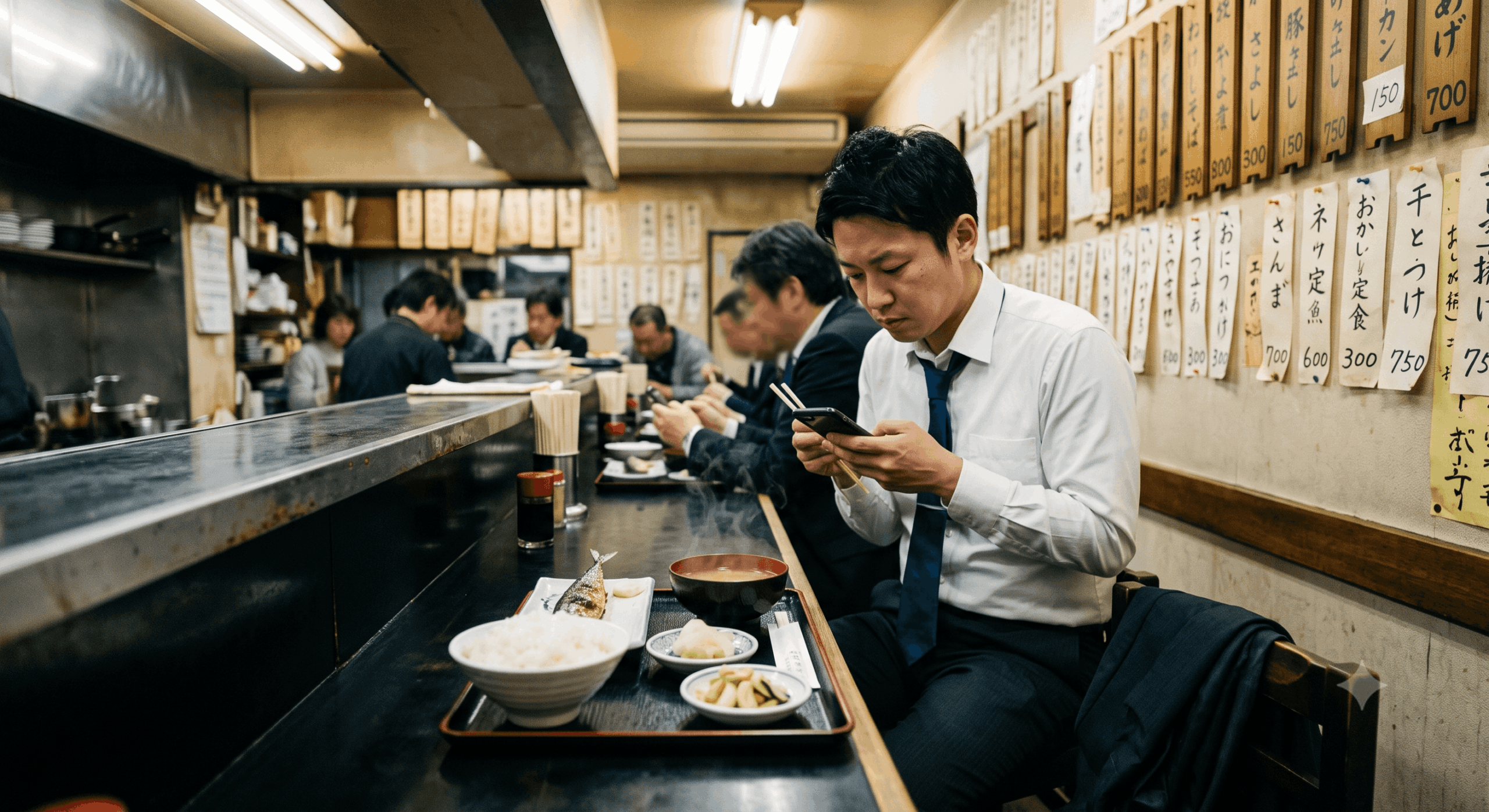
Near almost any station exit ringed by office towers in Tokyo, there is a restaurant like this one: no sign in English, no QR code menu, no influencer geotag, no reason for a tourist walking past to register it as anything other than background noise on the way to somewhere else. Inside, an 800-yen sashimi set draws a lunchtime queue of salarymen who have eaten there for years and will keep eating there for years more. This is, almost exactly, the point.
The meal in question is called teishoku — a fixed set built around one main dish, a bowl of rice, miso soup, and a small rotation of pickles and side dishes, typically priced between 800 and 1,500 yen depending on the city and the ambition of the kitchen. It is, structurally, one of the most quietly sophisticated food formats in the world, and almost nobody outside Japan has heard of it by name.
The format traces back to ichiju-issai — “one soup, one side” — the austere meal logic of Zen temple kitchens, later loosened and enriched as it migrated into the shokudo, the public cafeterias and neighborhood diners that have fed Japanese office workers since well before the postwar economic boom that the country is now most associated with abroad. What makes teishoku worth understanding isn’t nostalgia. It’s architecture. Rice sits to the diner’s left, soup to the right, the main dish at the back — an arrangement with enough quiet logic embedded in it that no one needs to explain it twice. The meal is not assembled for spectacle. It is assembled the way a sentence is assembled: each part doing exactly one job, the whole adding up to more than its parts.
What tourists tend to miss is not the food itself but the register it operates in. A teishoku counter is not trying to impress you. The handwritten menu strips taped to the wall, the faded laminate tables, the owner who has run the same eight-dish rotation for decades — none of this reads as charming to someone scanning for charm. It reads as ordinary, which is exactly the camouflage that has kept these places intact while the blocks around them filled with chain cafés optimized for a different kind of attention. In retro-leaning neighborhoods on the city’s edges — the kind locals half-jokingly call “Grandma’s Harajuku” — a humble shokudo might serve a ginger-pork teishoku for under 900 yen in a room that has not been redecorated in the way a “vintage-inspired” restaurant might be. It is not vintage-inspired. It is simply old, in the unbothered way a thing is old when no one has needed it to be anything else.
The economics matter here too. Lunch sets in Japan have crept upward — what was reliably under 1,000 yen a decade ago now often edges toward 1,200 or 1,500 — and restaurant owners have spoken candidly about the tension between rising costs and a lunch crowd that still expects the old price. That tension is itself a kind of cultural information: a teishoku lunch is not just a meal, it’s a small, daily negotiation between a business and its regulars, conducted in yen and loyalty rather than ratings and reviews.
To walk past one of these counters in favor of a more legible meal — a burger chain, a hotel breakfast, a café with an English menu and a recognizable name — is not a failure of taste. It’s simply a missed door. What’s behind it costs less than a single overpriced “Tokyo experience” photo op, and offers something far harder to manufacture: decades of unbroken, unglamorous repetition, done well, for people who were never trying to be seen doing it.
A note on specifics: the particular counter you find may not be the one your guidebook mentioned five years ago. These small, family-run places open, close, and change hands quietly, without press releases — which is, in its own way, part of the same lesson. Ask locally. Look for the queue of regulars, not the queue of cameras.
Crazy Escape knows which counters are worth the 40 seconds of not understanding the menu. If you want to go one step further and make the food yourself, alongside someone who’s been doing it for decades, start here. ➔ Onigiri Making in the Japanese Countryside — 48 USD / 3 hours