
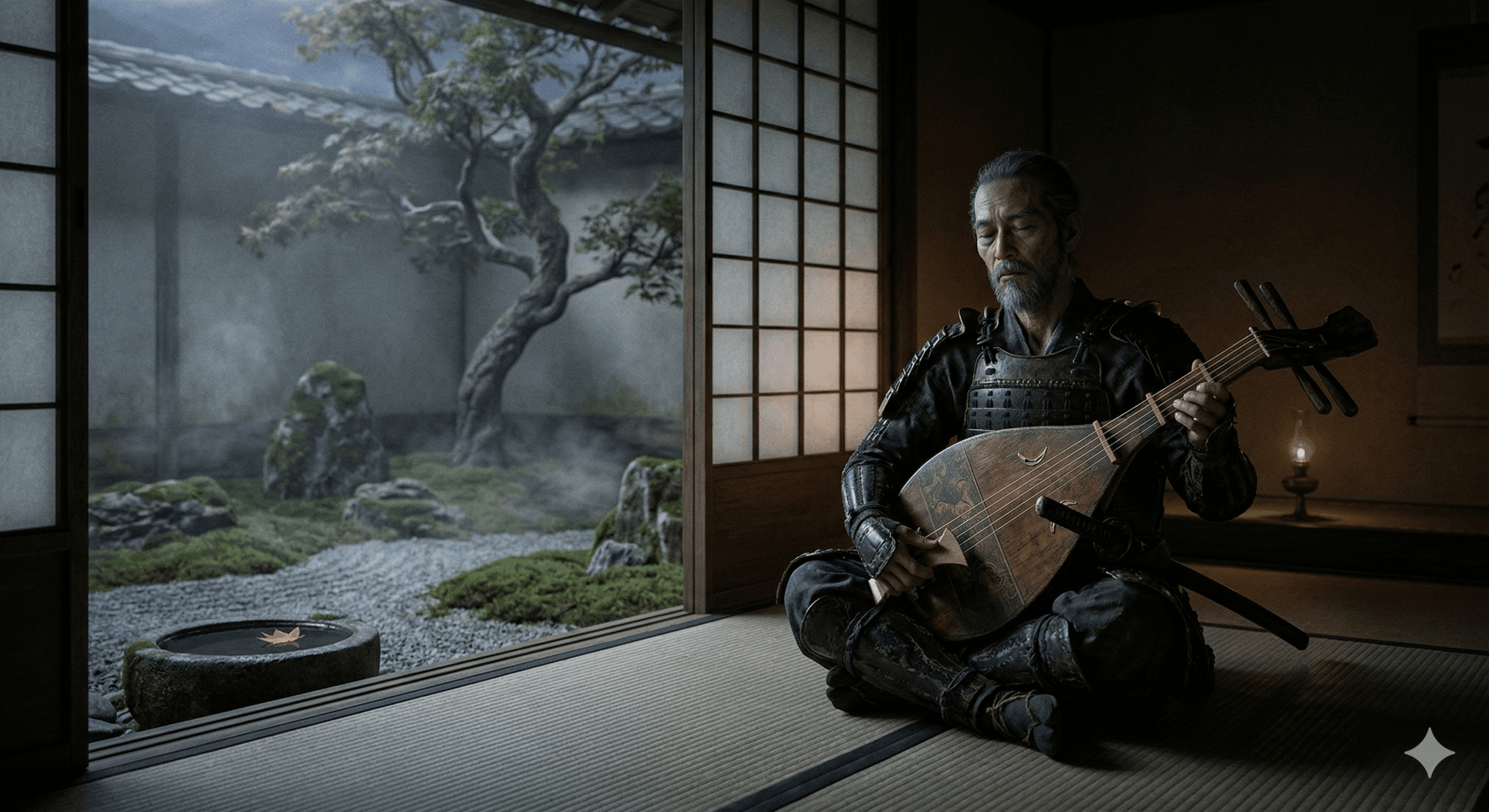
There’s a moment in a piece of Satsuma Biwa music that most first-time listeners completely misread.
The sound stops.
Not because the performer has finished. Not because something has gone wrong. The silence is the music.
In Japanese aesthetics, this pause has a name: 間 (Ma).
The Concept Most Translations Get Wrong
“Ma” is often translated as “negative space,” but that makes it sound empty — like something that’s simply not there.
That’s the opposite of what it means.
Ma is the charged space between things. The breath before a word. The moment a door closes and the room becomes its own world. The half-second after a biwa strike when the sound hasn’t yet decided to fade.
In Western music, silence is often treated as a break — a rest before the next note arrives. In the tradition of the Satsuma Biwa, silence is a presence in itself. It carries the weight of everything that just happened.
The note tells you what was played. The Ma tells you what it meant.
Why the Samurai Valued Restraint Over Volume
The Satsuma Biwa was not a decorative instrument. It was born in the Satsuma domain (present-day Kagoshima) and cultivated by samurai — not as entertainment, but as a form of mental and spiritual discipline.
The pieces it carried were stories of battle, honor, death, and loyalty. Heavy content, delivered with deliberate control.
A samurai who could sit with silence — who didn’t rush to fill every pause — was understood to be someone with mastery over themselves.
The Ma wasn’t weakness. It was the measure of composure.
What Silence Does to a Room
If you ever have the chance to hear the Satsuma Biwa performed live, pay close attention to what happens to the people around you when the sound stops.
Nobody checks their phone. Nobody shifts in their seat. The room holds its breath, waiting — and somehow, in that waiting, everyone becomes present at the same time.
That collective pause is Ma functioning exactly as it was intended.
It doesn’t ask you to slow down. It pulls you into slowness, without permission, before you’ve made a conscious decision to follow.
A Different Way to Meet an Instrument
Most music experiences ask you to learn something: a chord, a rhythm, a technique.
The Satsuma Biwa experience offered by Crazy Escape starts somewhere else entirely — with how you enter the room. With how you hold your body before the instrument. With posture, presence, and the quiet intention of someone who understands that the music has already begun before a single string is touched.
In a sense, you are being asked to practice Ma before you play it.
That’s not beginner’s guidance. That’s the heart of the tradition.
If This Resonates
You don’t need a musical background. You don’t need to know anything about Japanese history.
You just need the willingness to sit in a room where silence is taken seriously — and let something quietly rearrange how you think about sound, space, and attention.
If that sounds like your kind of afternoon, the SAMURAI SOUND – Satsuma Biwa Experience is 70 minutes in Yamato City, Kanagawa, led by a professional biwa artist with an international performance record.