
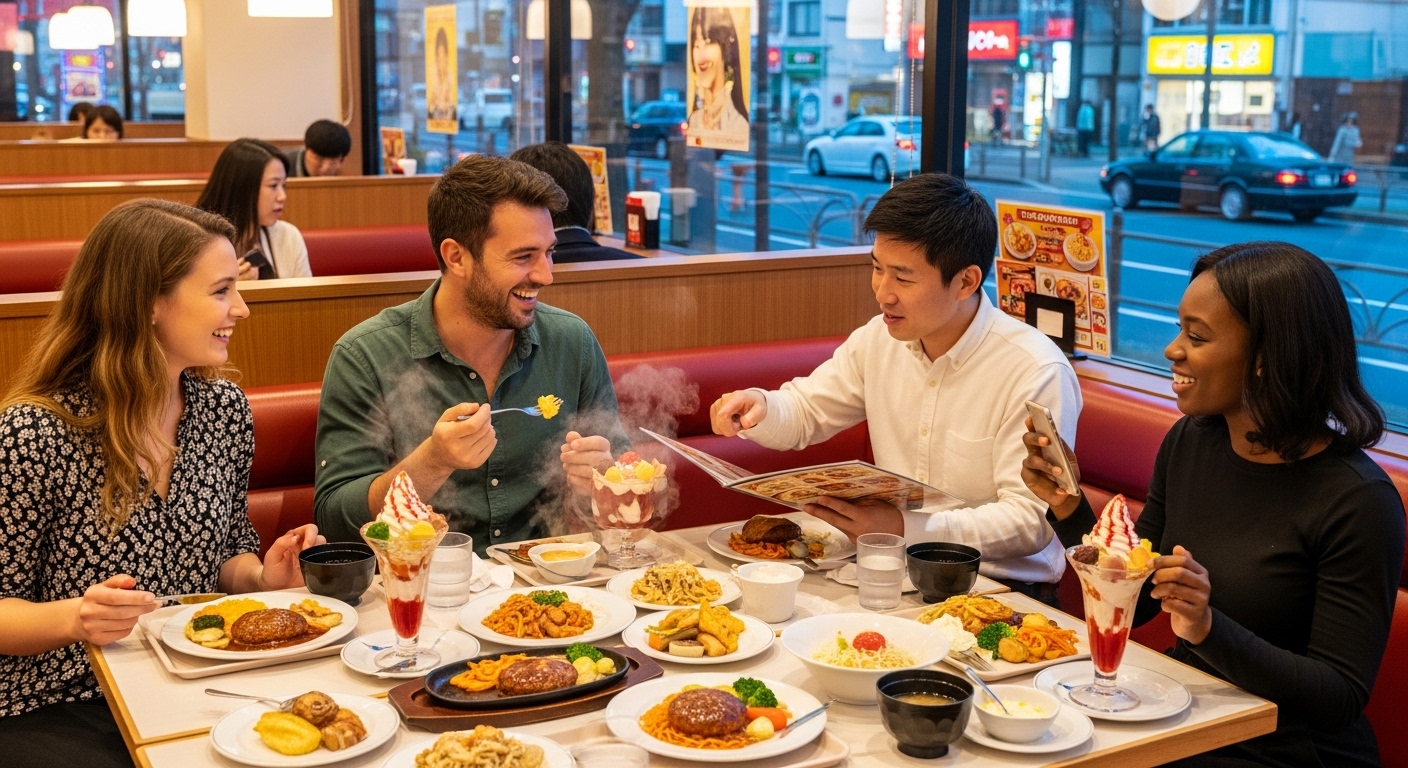
It’s 2 a.m. You’ve missed the last train. Your hotel is an hour away, and Tokyo’s streets are surprisingly quiet. But look around—locals aren’t panicking. They’re walking calmly toward those brightly lit signs you’ve been ignoring all week: family restaurants.
While tourists chase Michelin stars and Instagram-worthy ramen shops, millions of Japanese people eat, work, and hang out in famiresu—Japan’s 24/7 family restaurant chains. They’re not glamorous. They won’t make your travel highlight reel. But they might just save your trip.
What Exactly Are Family Restaurants?
Family restaurants (famiri resutoran, shortened to famiresu) are Japanese diner chains serving affordable Western-style and Japanese fusion food. Think Denny’s, but uniquely evolved for Japanese tastes and lifestyle.
The big names you’ll see everywhere: Gusto, Saizeriya, Jonathan’s, Royal Host, Denny’s Japan, and Coco’s. Each has hundreds of locations across Tokyo, many open 24 hours, and most with menus in multiple languages.
A full meal typically runs ¥600–¥1,200 per person. Not the cheapest option in Japan, but considering what you get—unlimited drinks, Wi-Fi, power outlets, and the right to sit for hours without judgment—the value becomes clear.
Why Travelers Should Care
Here’s what makes family restaurants surprisingly useful for visitors:
Open When Nothing Else Is
Most Tokyo restaurants close by 11 p.m. Convenience stores stay open, but good luck finding a place to sit and actually eat. Family restaurants? Many locations never close. Breakfast at 6 a.m., late dinner at midnight, emergency landing spot at 3 a.m.—they’ve got you covered.
Solo-Friendly by Default
In Japan, eating alone is completely normal, and family restaurants are designed for it. Single-seat counters, booths with dividers, and a culture where nobody thinks twice about someone dining solo. No awkward “table for one?” moments.
Digital Nomad Ready
Free Wi-Fi. Power outlets at most seats. Unlimited drinks. Staff who won’t rush you. Japanese students and remote workers have known this forever—family restaurants are excellent temporary offices. Order something every hour or two, and you can camp out all day.
Budget-Conscious Without Sacrificing Quality
A decent Hamburg steak with rice, soup, and salad bar? ¥800. Pasta that’s honestly better than it has any right to be? ¥500–¥700. Add the all-you-can-drink soft drink bar for ¥300–¥400, and you’ve got a meal that leaves you satisfied without emptying your wallet.
7 Things You Need to Know
1. The Drink Bar Is Your Best Friend
For ¥300–¥450, you get unlimited soft drinks, coffee, tea, and sometimes soft-serve ice cream. The catch? It’s per person and typically available only with a food order. But for long stays or multiple people, it’s unbeatable value.
2. Ordering Systems Vary
Some locations use ticket machines at the entrance (like many ramen shops). Others have you order from a tablet at your table. Most still use traditional paper menus with a call button. If you’re unsure, just ask: “Chūmon wa dō sureba ii desu ka?” (How do I order?)
3. The Call Button Is Magic
See that button on your table? Press it when you’re ready to order or need something. A chime sounds in the kitchen, staff comes to you, and you never have to flag anyone down. It’s one of Japan’s most civilized inventions.
4. Long Stays Are Expected
Unlike many restaurants that want table turnover, family restaurants are built for lingering. Students study for exams. Salarypeople decompress after late shifts. Tourists rest their feet between neighborhoods. Stay an hour, stay three—nobody minds as long as you’ve ordered something.
5. Picture Menus Save Lives
Even if your Japanese is limited, family restaurant menus are photo-heavy. Point and nod works perfectly. Many chains also offer English, Chinese, and Korean menu options via QR codes or tablets.
6. Smoking Sections Still Exist
Some locations still have designated smoking areas. If you’re sensitive to smoke, confirm you’re in the non-smoking section: “Kinen seki onegaishimasu.”
7. Seasonal Menus Rotate
Don’t sleep on limited-time offerings. Japanese family restaurants take seasonal menus seriously—cherry blossom-themed desserts in spring, pumpkin everything in fall, hot pot sets in winter. These items often rival specialty shops in creativity.
When Family Restaurants Actually Save the Day
Missed the Last Train
The classic scenario. It’s past midnight, the trains have stopped, and a taxi to your hotel costs ¥5,000. A family restaurant breakfast set costs ¥600. Do the math, grab a booth, maybe doze a bit (discreetly), and catch the first train at 5 a.m.
Early Morning Before Your Hotel Check-In
Landed at Narita at 6 a.m. and your hotel won’t let you check in until 3 p.m.? Family restaurant near your hotel becomes your base. Store your luggage at the station, camp at Gusto with your laptop and unlimited coffee, and actually feel human again.
Rainy Day Refuge
Typhoon season or sudden downpour? Duck into the nearest family restaurant. Dry off, warm up with soup and hot tea from the drink bar, and wait out the worst of it in comfort.
Work Session Between Activities
Got three hours between your museum visit and dinner reservation? Find a Jonathan’s, order something light, and knock out those emails or plan tomorrow’s itinerary over unlimited coffee.
Phrases to Navigate Like a Local
- “Kinen seki onegaishimasu” (禁煙席お願いします) — “Non-smoking seat, please”
- “Dorinku bā wa arimasu ka?” (ドリンクバーはありますか?) — “Do you have a drink bar?”
- “Kore to kore, onegaishimasu” (これとこれ、お願いします) — “This and this, please” [while pointing at menu]
- “O-kaikei onegaishimasu” (お会計お願いします) — “Check, please”
- “Betsu-betsu de onegaishimasu” (別々でお願いします) — “Separate checks, please”
Most family restaurants let you pay at your table or at a register near the exit. If you’re unsure, ask: “Doko de haraimasu ka?” (Where do I pay?)
Menu Items Worth Trying
The Reliable Standards
- Hamburg steak sets (¥700–¥900) — Japan does this better than anywhere
- Pasta (¥500–¥800) — Saizeriya’s Milan-style doria is cult-favorite
- Curry rice (¥600–¥800) — Comfort food that never disappoints
- Morning sets (¥400–¥600) — Toast, eggs, coffee, salad before 10 a.m.
The Surprisingly Good
- Japanese-style pizza (¥600–¥900) — Teriyaki chicken, mentaiko, corn toppings
- Dessert parfaits (¥400–¥700) — Elaborate, Instagram-worthy, massive
- Seasonal hot pots (¥900–¥1,200) — Winter only, feeds two easily
- Kids’ menu (¥400–¥600) — Portion-controlled and oddly appealing for light eaters
Why This Matters for Your Japan Experience
The secret to traveling well isn’t hitting every famous spot—it’s knowing where locals go when they need something real. Family restaurants are where Japanese people study for entrance exams, have first dates, hold small business meetings, and kill time between life’s moments.
They’re not exotic. They won’t give you bragging rights. But they’ll give you something better: a glimpse of how actual daily life works in Japan. The teenager cramming kanji at the next table, the salaryman nursing his third coffee at midnight, the elderly couple sharing a dessert—this is the Japan that exists between the tourist moments.
Plus, there’s something deeply comforting about knowing that no matter what happens—missed train, rainy day, early morning, late night, dead phone, empty stomach—there’s a warm, well-lit place with decent food and unlimited coffee waiting for you.
Your Next Move
Ready to explore Tokyo beyond the guidebook highlights?
Discover deeper Tokyo experiences →
Small-group experiences with knowledgeable local guides show you the Tokyo that locals actually live in—not just the postcard version. From neighborhood food culture to after-hours exploration, find experiences that match your curiosity. No tourist traps, no surface-level tours—just authentic connections and the kind of insights you’d only get from a friend who actually lives here.