
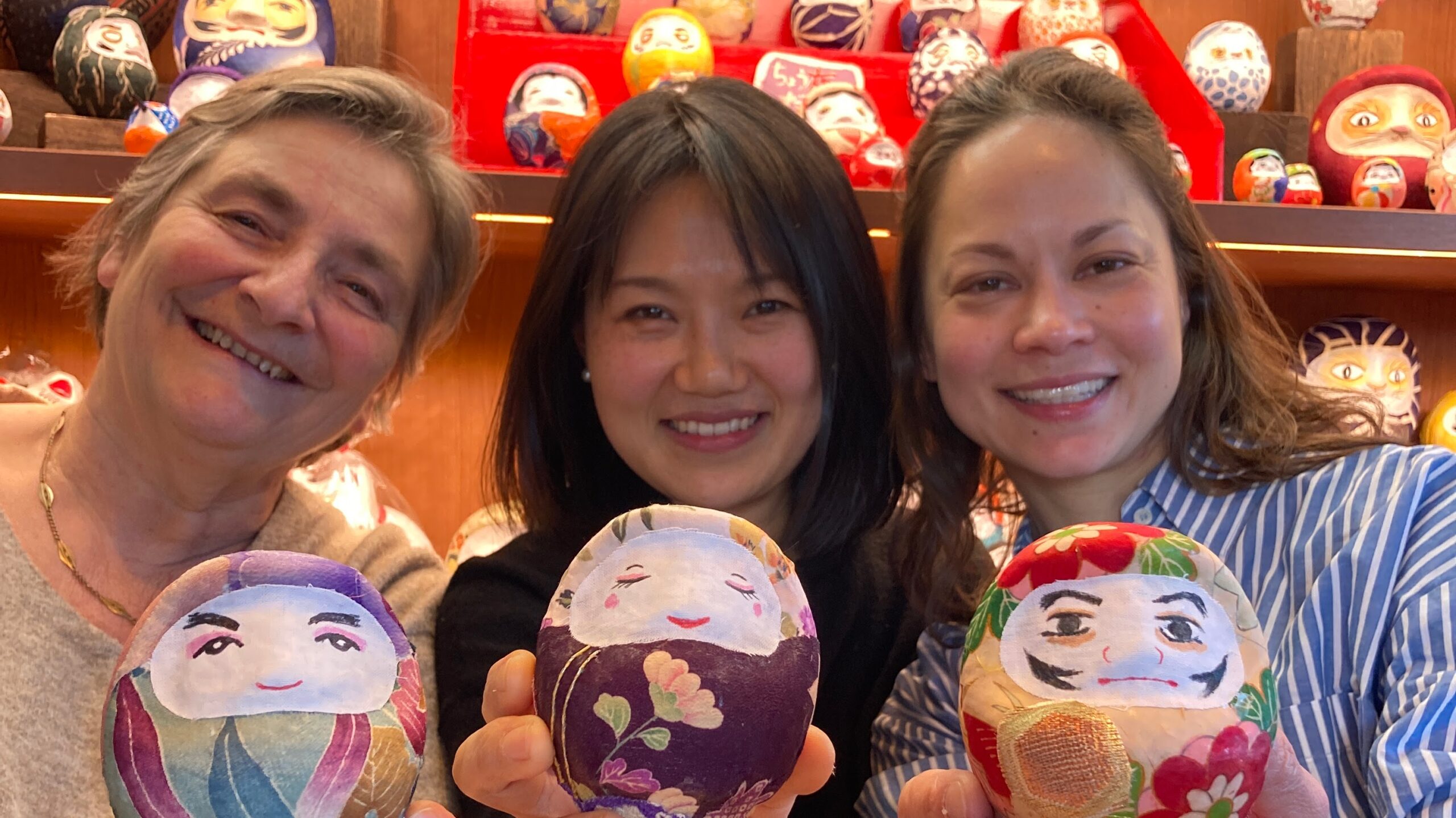
At first, the table looks almost impossible to choose from.
There are vivid reds, quiet indigo blues, tiny flowers, bold geometric shapes, delicate seasonal motifs, and pieces of fabric that once belonged to kimono or yukata. Each one could become part of a Daruma. No two combinations will ever be exactly the same.
This is where the experience really begins.
Choosing fabric is not simply decoration. Japanese patterns have long appeared on kimono, wrapping cloth, ceramics, lacquerware, and everyday objects. Some carry traditional wishes; others recall a season, a place, or a personal memory. When you place them on a Daruma connected to your own intention, the design becomes part of the story.
The Pattern Can Carry a Wish
One familiar Japanese motif is seigaiha, a repeating pattern of overlapping waves. The waves continue without end, and the design has long been associated with wishes for lasting happiness and peace.
Crane motifs are often connected with longevity and vitality. Floral patterns may evoke a favorite season or a particular atmosphere: the freshness of spring, the energy of summer, or the quieter beauty of autumn.
Then there are geometric patterns such as checks, diamonds, and repeated lines. Even when you do not know the traditional name, their rhythm can create a strong visual identity. A tightly repeated pattern may feel calm and orderly. A large, colorful motif may feel bold and optimistic.
Not every piece of cloth needs to have a fixed symbolic meaning. Sometimes you simply respond to a color or shape before you can explain why. That instinct is also a valid way to choose.
The available fabrics vary, which is part of the pleasure. You are not selecting from a catalogue with one correct answer. You are working with the materials in front of you and deciding what belongs together.
Three Ways to Choose Without Overthinking
1. Begin with the feeling, not the color name
Before touching the fabric, decide what you want your Daruma to represent. Do you want energy, calm, courage, focus, playfulness, or a new beginning? Once you have a feeling in mind, the selection becomes easier.
2. Choose one fabric to lead
Find the piece you are most strongly drawn to and make it the center of the design. Other fabrics can support it with quieter colors or smaller patterns. This keeps the finished Daruma expressive without making every surface compete for attention.
3. Look at the combination from a distance
A pattern can look very different when it is cut into a small shape. Place a few pieces together, move back slightly, and notice what catches your eye first. You can change the balance before attaching anything.
There is no need to plan every detail from the beginning. The design often develops as you work.
Why Old Fabric Feels Different From a New Souvenir
A mass-produced souvenir arrives complete. A handmade Daruma records a sequence of decisions.
You chose this flower instead of that stripe. You placed an unexpected color beside a traditional motif. You adjusted a piece because the first shape did not sit quite right. Those small choices remain visible in the finished object.
The fabric brings its own texture and history as well. Kimono and yukata cloth was designed to move with a person and to be seen in changing light. Reusing it on a Daruma gives the material a new life without erasing its connection to Japanese craft.
This does not require artistic experience. Cutting, arranging, and layering fabric is approachable, and the process naturally slows you down. Many people become absorbed in the simple work of looking closely, choosing carefully, and using their hands.
A Personal Daruma Near Jindaiji Temple
Jindaiji in Chofu has a deep connection with Daruma culture. Its Daruma Fair, held each year on March 3 and 4, is considered one of Japan’s major Daruma markets. Outside the festival season, the green temple neighborhood offers a quieter setting in which to encounter the tradition.
In Crazy Escape’s private workshop near Jindaiji Temple, you can create a one-of-a-kind Chofu Daruma using authentic Japanese fabrics, including kimono and yukata cloth. You begin with your own wish or intention, then build a design around it through color, pattern, and texture.
The result is easy to carry home, but it does not feel like something taken from a souvenir shelf. It holds the memory of making it: the fabric spread across the table, the choices that changed along the way, and the moment the separate pieces finally looked like they belonged together.
If you want a Japanese keepsake that reflects your own taste and intention, make the design yourself.
Create your own lucky Daruma with Crazy Escape
The most meaningful pattern may not be the one with the most famous symbolism.
It may simply be the one you chose.