
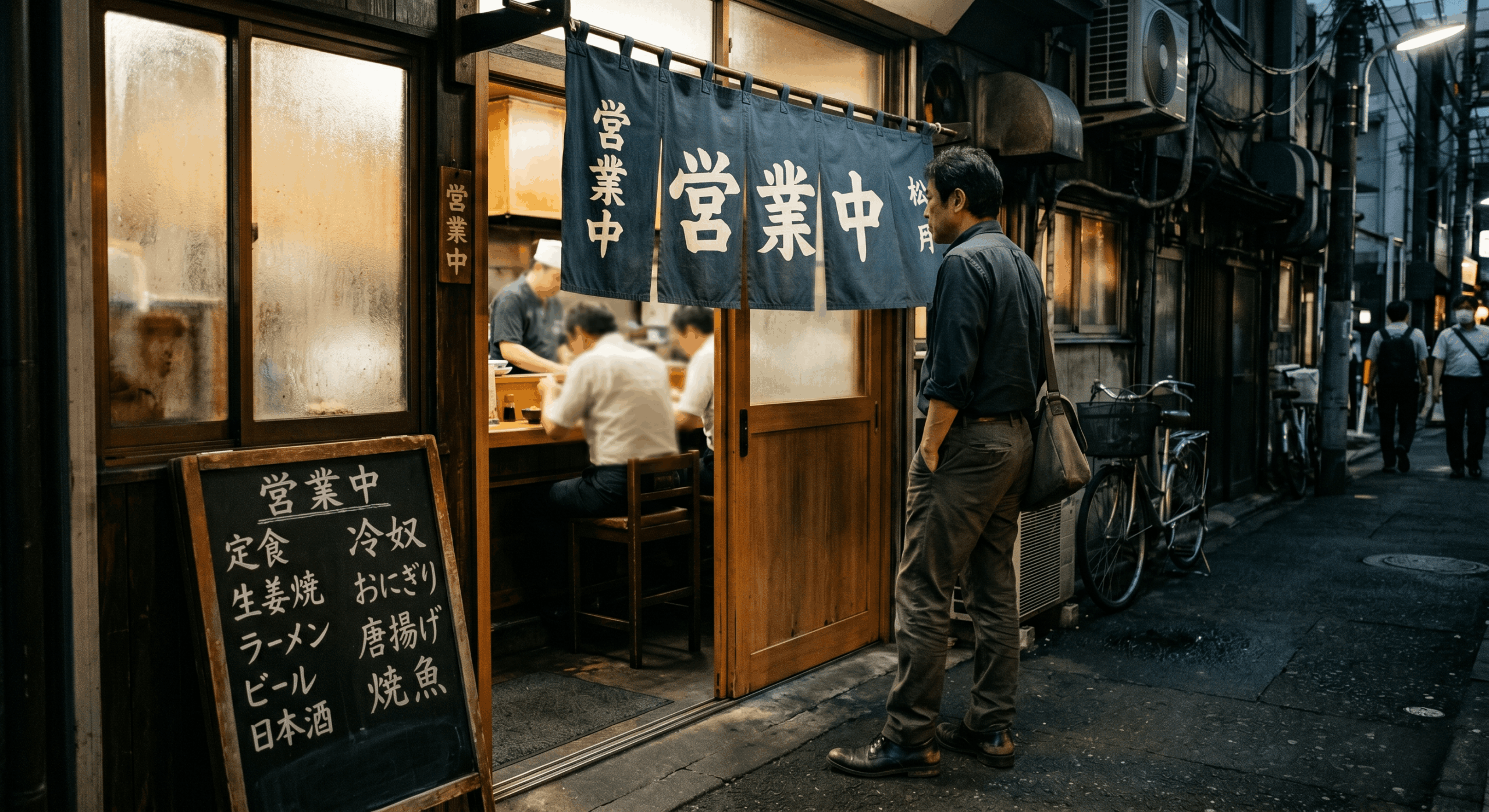
There is a particular kind of traveler who has visited Japan three times and eaten, each evening, beneath the same cold fluorescent lights. They have photographed the egg salad sandwich in its cellophane sleeve. They have documented the fried chicken retrieval from the heated case with the urgency of an anthropologist. They have posted the ramen cup, the onigiri, the melon bread — and they have received, for their trouble, the warm approval of an algorithm that has never left the airport. What they have not done is eat dinner in Japan.
This is not a small distinction.
The convenience store — the konbini, in the compressed, affectionate shorthand of the Japanese — is a genuine feat of industrial civilization. Its supply chain is a marvel; its interior logic, a kind of controlled poetry. At seven in the morning, with a train to catch and a brain not yet fully operational, the konbini is a grace. As a recurring evening ritual, it is something closer to a self-imposed quarantine from one of the most sophisticated culinary cultures in human history. The machine has been optimized. The meal has not been cooked. These are different things, and the difference matters.
What social media has accomplished — with its ten-second reels of cellophane being torn, its AI-scored montages of plastic packaging glowing under LED warmth — is to flatten Japan’s food culture into its most reproducible surface. The konbini photograph well. They are open at 2 a.m. They require no Japanese, no courage, no surrender to the minor vertigo of not quite knowing what you are about to eat. They are, in the language of the algorithm, extremely low friction. And friction, it turns out, is where all the interesting things live.
Three blocks from any konbini in any mid-sized Japanese city, there is a door. It may be sliding wood, worn to a grey softness by decades of the same hands. There is a noren curtain, indigo or dirty white, and behind it: a shokudo, a soba-ya, an izakaya that has been in one family’s hands long enough that the second generation has begun to teach the third. The menu is handwritten. The stock changes with the season, because the cook bought what was good that morning rather than what the corporate algorithm had pre-positioned overnight. The dashi — the foundational broth from which Japanese cuisine reasons outward — has been simmering since before you woke up. It will taste, with precision, of time.
To enter such a place requires approximately forty seconds of mild discomfort. You will not fully understand the menu. You may point. The proprietor, who has spent forty years mastering this specific register of hospitality — neither effusive nor cold, present without being intrusive — will nod. What arrives at your table will not be optimal for photography. It will be optimal for eating.
The cultural critique here is not of the konbini itself, which is blameless and useful and genuinely extraordinary on its own terms. The critique is of a travel logic that has mistaken the emergency infrastructure for the destination. Japan’s micro-culinary ecosystem — its neighborhood diners, its standing ramen counters, its regional izakaya with menus that exist nowhere online and proprietors who have no interest in being discovered — constitutes one of the deepest and most democratically accessible food cultures on the planet. It is available to anyone willing to slide open a door they do not entirely understand.
Veteran visitors returning to r/JapanTravel and r/JapanTravelTips are increasingly articulate on this point: the konbini as occasional resource is a tool; the konbini as nightly default is a kind of failure of nerve. Not moral failure — travelers should not be made to feel small for wanting the known quantity at the end of a long day. But a failure, nonetheless, of the curiosity that presumably brought them to Japan in the first place.
The egg salad sandwich is not the reason you crossed twelve time zones. It was never supposed to be.
[Beyond the Filter] If you are ready to slide open the weathered wooden doors that the algorithms cannot find, you need more than a screen. You need an insider. Discover the true masters of Japan’s cultural underground with Crazy Escape. ➔ Explore Our Curated Experiences on Crazy Escape