
There is a moment in a traditional Japanese tea ceremony that confuses most first-time visitors.
The host lifts the whisk. Prepares the bowl. And then — stops. Not because something went wrong. Not because they forgot a step. They simply pause, completely still, for a few seconds that feel much longer than a few seconds.
First-time visitors don’t know what to do with this. They shift in their seats. Check if something is about to happen. Wonder if they should say something.
And then the ceremony continues.
What they just witnessed wasn’t emptiness. It was ma — and it was, in many ways, the most important moment in the entire ritual.
1. The Word That Doesn’t Translate
Ma (間) is one of those Japanese concepts that English keeps trying to translate and never quite managing.
The dictionary will tell you it means “gap,” “pause,” or “negative space.” And technically, those are correct. But they miss the point entirely — because in the Japanese understanding, the space between things isn’t empty. It is full of meaning. It is where the real communication happens.
Think of it this way: in music, a note has pitch and duration. But what gives a melody its feeling isn’t just the notes — it’s the silence between them. Remove the pauses and you don’t just change the music. You destroy it. What remains is noise.
Ma is that silence. And Japan has spent centuries understanding that it deserves as much attention as the notes themselves.
2. Ma Is Everywhere, Once You Know to Look
Once you understand ma, you start seeing it everywhere in Japan — in places you would never have thought to look.
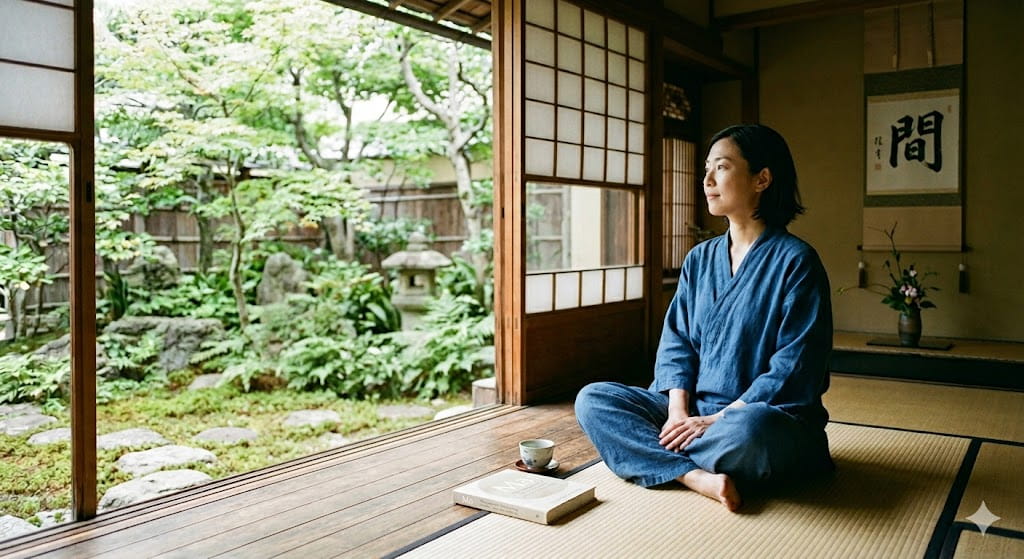
In architecture. A traditional Japanese room is built around its empty space. The tokonoma alcove exists to hold one object — a single scroll, a single flower — surrounded by emptiness that makes both the object and the space more significant. Western design fills every corner. Japanese design frames the unfilled ones.
In conversation. Japanese communication is famously comfortable with silence. A pause after a question isn’t awkwardness — it’s respect. It means the other person is considering what you’ve said seriously enough not to rush their response. The pause is the response, before the words arrive.
In gardens. The raked gravel of a Zen garden isn’t decoration. It’s ma made physical — a representation of stillness, of the spaces around the rocks that give the rocks their meaning.
In food presentation. A kaiseki meal arrives in courses, each plate with deliberate empty space around the food. The emptiness isn’t waste. It’s context. It tells you: look at this. Just this. Nothing else right now.
3. Why the Modern World Forgot This
Here is a quiet irony: the concept of ma has never been more relevant than it is right now — and we have never been worse at practicing it.
We fill every pause. A moment of silence in conversation becomes a phone check. A commute becomes a podcast. A meal becomes a scroll through notifications. Waiting has become something to be eliminated rather than inhabited.
We have built an entire infrastructure designed to ensure that nothing — not a single moment — goes unfilled.
And what we’ve lost in the process is harder to name than what we’ve gained. A certain quality of attention. The ability to be in a moment rather than passing through it. The understanding that the space around an experience is part of the experience.
Ma is a word for what we’ve been losing without realizing it.
4. The Feeling of Ma in Practice
The interesting thing about ma is that you don’t learn it intellectually. You feel it — or you don’t.
You feel it standing in front of a Zen garden in Kyoto, when the stillness of the raked gravel starts to feel less like absence and more like presence.
You feel it in the pause before a taiko drum strikes — that held breath where the silence is so full it almost has weight.
You feel it in the space between notes when a biwa — Japan’s ancient lute — is played by someone who understands that what they don’t play matters as much as what they do.
You feel it in a tea ceremony, when the host’s pause stops being confusing and starts being the clearest thing in the room.
These aren’t spiritual moments reserved for monks. They’re available to anyone willing to slow down long enough to notice them.
5. How to Bring Ma Into Your Time in Japan
Understanding ma changes how you travel.
It means building pauses into your itinerary instead of filling every hour. It means sitting in a garden for longer than feels comfortable, until the discomfort passes and something else arrives. It means letting a meal take the time it wants to take. It means being in a temple without photographing it first.
It means, sometimes, putting the phone down and letting Japan happen to you rather than collecting it.
The travelers who come away from Japan feeling like they understood something — not just saw something — are usually the ones who found ma without looking for it. They lingered. They let silences exist. They discovered that the country rewards patience in ways that a packed schedule never will.
6. Experience the Space Between
Some experiences are designed to be consumed quickly. Others are designed to be inhabited.
At Crazy Escape, our experiences are built for the second kind. Whether it’s the focused stillness of a Shodō calligraphy session, the ancient resonance of a Biwa performance, or the unhurried ritual of a tea ceremony — each one is a doorway into ma.
Not as a concept. As a feeling.
Because some things in Japan can’t be explained. They can only be experienced slowly enough to be understood.
The pause is not where nothing happens. It is where everything that matters has room to exist.
Ready to experience Japan at the pace it was designed for? 👉 Explore our cultural experiences in Tokyo