
Most cultures have a soft spot for wishing.
Close your eyes. Picture the future. Blow out the candles.
You’ve “done something,” even if nothing changes.
Japan has a different relationship with the idea of luck.
It’s not that people don’t believe in it.
It’s that luck is treated as suspicious unless it comes with a form.
Daruma is that form.
Not a cute doll.
Not a tourist trinket.
A physical way of saying: I’m not just hoping. I’m committing.
The detail people miss: one eye stays blank
If you’ve seen a Daruma before, you’ve probably noticed the face.
The eyebrows. The mustache. The intense stare.
And often: one eye filled in, one eye left blank.
That isn’t decoration. It’s a contract.
The blank eye is what makes Daruma feel very Japanese—because it turns intention into something you can’t ignore. It sits in your room and quietly asks:
Are you still the person who wanted that thing?
Daruma doesn’t motivate you with hype.
It motivates you with presence.
Buying a Daruma is easy. Making one changes the meaning.
Here’s the gap most travelers never cross:
You can buy a Daruma in minutes.
But if you make one, the object stops being “Japanese-looking” and starts being yours.
In Chofu—near Jindaiji Temple, a place with a Daruma tradition and a famous Daruma Market held each March—you can craft a “Chofu Daruma” in a small workshop that leans into exactly that idea.
This isn’t painting. It’s not “art class.”
You build the Daruma the way Japan often builds commitment: through small, deliberate steps.
What you actually do: write first, then design
The workshop starts in a way that feels almost too direct:
You begin by inscribing your wish onto the Daruma’s body.
Not a vision board. Not a vague vibe.
A sentence, placed onto the object.
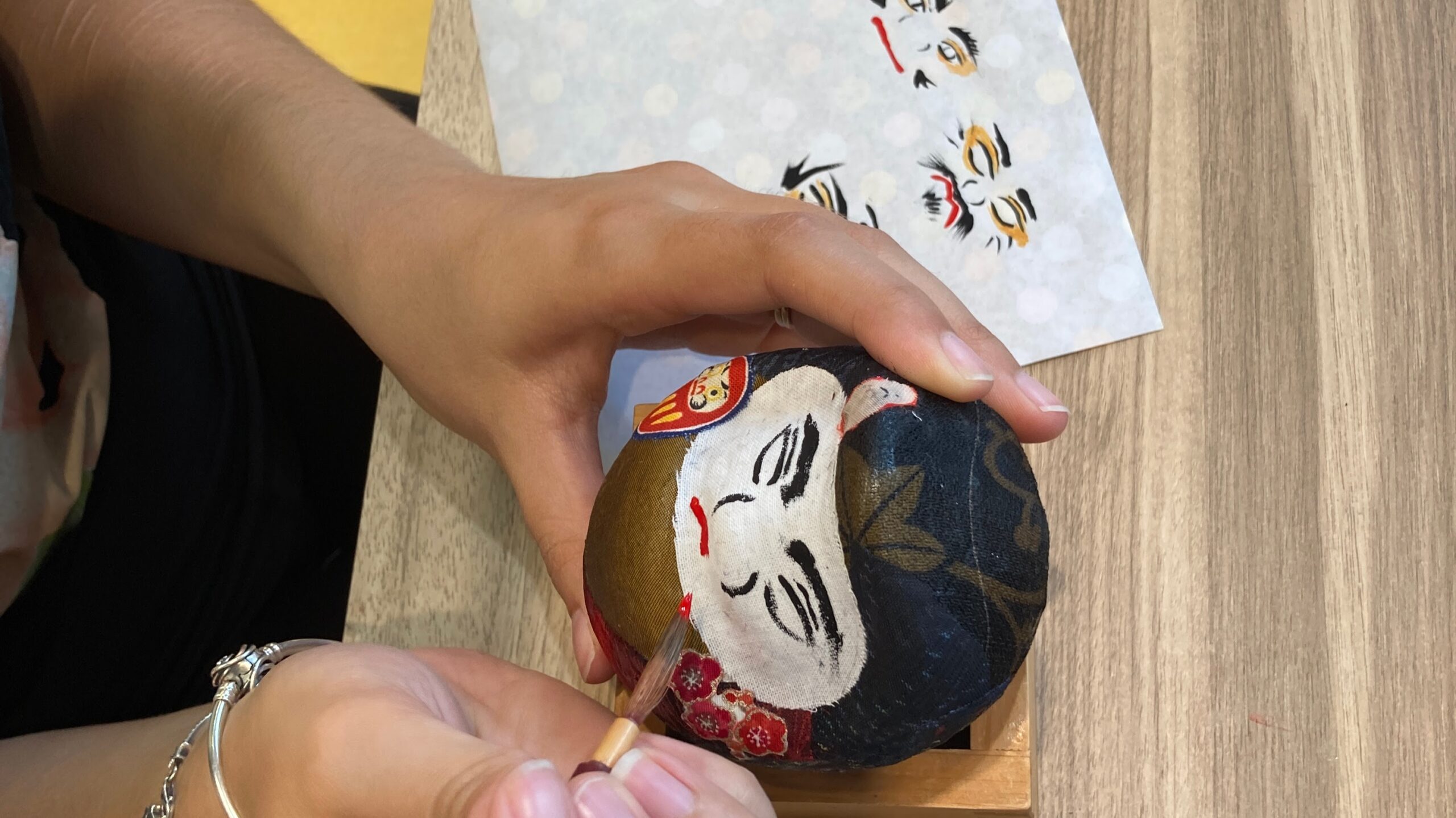
Then you choose from a selection of authentic Japanese textiles—kimono fabric, yukata, and even kakishibu (persimmon tannin)–dyed cloth—cutting and layering patterns to create your Daruma’s “skin.”
This matters, culturally.
Because Japan is a place where meaning often lives in surfaces—texture, material, restraint, repetition. A pattern isn’t just pretty. It’s a decision you’ll keep looking at.
The process is unexpectedly absorbing: cut, place, adjust, press.
Many people slip into that calm, focused state where your hands start moving faster than your overthinking.
Then you give it a face (and a deadline)
After the fabric is applied, you practice face designs on paper, then draw the Daruma’s face—either with a brush pen or more traditional tools.
This is the moment it becomes “alive.”
And once it has a face, it’s no longer just an object you made.
It’s an object that can look back at you.
That’s the quiet genius of Daruma: it turns your goal into something visible enough to be slightly uncomfortable.
In a culture that values not over-declaring yourself, Daruma is a socially acceptable way to say:
This matters to me.
Why this feels “outside the usual tourist template”
Because nothing here is about collecting “Japan highlights.”
It’s about encountering a Japanese mechanism for follow-through—one that doesn’t use speeches, pep talks, or personal branding.
Just:
- one wish written plainly
- one body built by hand
- one face that stays with you
- and yes, one eye that can remain blank until you’ve earned it
If you’ve been craving a Japanese day that feels less like consumption and more like calibration, this is the kind of experience that quietly rewires how you read the culture.
Booking
If you want to make a Daruma that actually means something—rather than buying one that simply looks the part—you can book “Craft Your Own Lucky Daruma” on Crazy Escape.
- Location: Jindaiji, Chofu, Tokyo (near Jindaiji Temple)
- Duration: ~90 minutes
- Format: Private session (1–4 people)
- Times: 11:30–13:00 or 14:00–15:30
- Price: 80 USD / person
Booking link: